
What creating an AI faculty for LumenVie re-taught me about Community of Inquiry, authenticity, and online learning

I
really messed up. And I should have known better.
As
the associate director of digital learning at a public institution, I know a
lot about the community of inquiry framework. I have spent years talking about
presence, especially in online courses where folks are not meeting in person or
in real time. I spent hours reading research on it, writing about it, using the
framework in trainings.
But what did I do?
I
didn’t follow my own advice or use my own logic when it came to applying the
Community of Inquiry framework to my microlearning platform. I threw all my
logic out the window and got too caught up in the newest technology.
And
this… is how it all started.
During
the pandemic lockdowns, I came up with the idea to build a community of
practice for educators as we figured out how to transition faculty to teach
online. The idea grew even more when we returned to campus after the pandemic,
and AI started to take off. Eventually, I created a microlearning platform
called LumenVie. Part of this bright idea of mine was to create an avatar-based
faculty that could help deliver content and make the learning experience more
engaging through storytelling.
And,
if I am being fairly honest, there was also a practical reason.
I
know I am not the most interesting person to listen to for hours at a time. As
an ESL learner, with a stutter that comes out sometimes, and a quirky New York
accent (hey, yo, you…), I thought avatars could help, you know… make me a
little more presentable on the interwebs and socials. The only problem was that
I am not an animator, illustrator, or character designer, and this is where AI
came in and made it possible for me to experiment with something I probably
would never have attempted a few years ago.
So
I created several faculty avatars based on my roles in higher education over
the years. Each has a name, personality, role, and visual identity that lived
in my mind. And the other part of this project was to create DS, an avatar meant to
represent me on the platform and give me some kind of “presence” on it. I liked DS. DS was my alternate personality,
or at least how I thought I would sound if I presented myself as a bit more
scholarly in academic spaces (yes, imposter syndrome is real, my friends,
especially when you are also working through a dissertation…)
Apparently,
DS was not enough to create a sense of presence.
After
I finished the avatars, I created some animations and shared them with my pilot
testing groups. The feedback was good. People liked the idea. They liked the
characters. They could see how an avatar-based faculty might work within
short-form learning. I knew the idea was solid and maybe, just maybe, there was
interest in something like LumenVie in the micro-learning spaces.
Then
I started reading the comments and feedback about DS.
Folks who actually knew me and my work in higher education kept saying the same thing. DS doesn’t feel like you, DS doesn’t sound like you. So, I created varying forms of DS, still missing that point. The avatar versions all looked and sounded fine. Nothing was wrong with DS. In fact, I used a version of it for my dissertation survey campaign and got many respondents when I posted participant request videos using DS. But those folks didn't know me, and those who did couldn’t connect DS to the person they knew. The character on the screen just wasn't me.
The
sense of presence, or should I say my presence, just wasn’t there.
A
wow moment, for sure, that completely went over my head when I was developing
DS.
So, What Exactly Is Community of Inquiry?
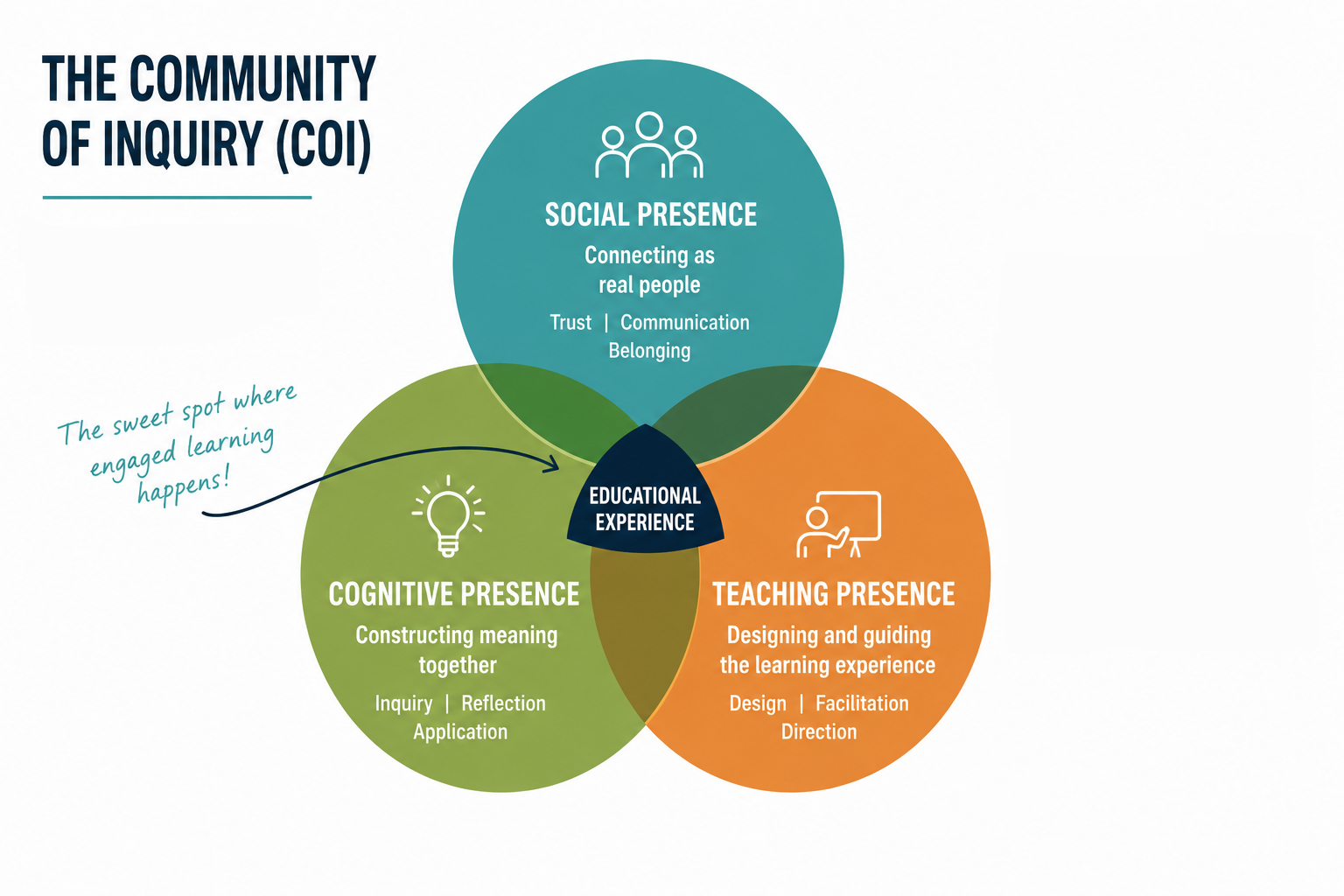
That last part is important.
We sometimes talk about online education as though good content is enough. Record the lecture, upload the readings, build the quiz, add a discussion board, and you are done. But learning doesn't quite work that way. A course can have excellent information and still feel strangely empty to the learner without interaction. The Community of Inquiry framework helps explain why presence matters in these spaces, especially on microlearning platforms. Let’s take a look at what presence actually means within the CoI.
The Elements of Presence
Social Presence: Is Anyone Actually Here?
Teaching Presence: Someone Has to Design the Experience
And Then There Is Authenticity
Authenticity
is not one of the three formal presences in the Community of Inquiry framework.
But my experience with DS made me think much more carefully about its
relationship to presence. If social presence depends partly on our ability to
present ourselves as real people within a learning community, then what happens
when the “person” learners encounter is intentionally artificial?
That is not just an avatar question. It is quickly becoming an online education question. We now have AI-generated instructors, synthetic voices, automated feedback, chatbots, virtual tutors, avatars, and increasingly sophisticated digital agents entering educational environments. I don't necessarily think that is a bad thing. I am building with some of those technologies myself. My mistake was not creating the DS avatar. My mistake was assuming that visual representation automatically created a connection.
It
didn't.
For
people who didn't know me, DS may have simply looked like another member of the
LumenVie avatar faculty. For folks who did know me, something was off. The
character didn't match their experience of me.
And it reminded me that authenticity online doesn't necessarily mean just
showing up on camera but creating enough consistency between our voice,
personality, communication, behavior, and digital representation that learners
understand who or what they are interacting with.

Microlearning Platforms Need Presence Too
It's easy to think presence on microlearning platforms doesn't matter because the content is shorter. I am beginning to think the opposite. When learners spend less time on your platform, they have fewer opportunities to establish connections. In a traditional semester-long course, an instructor may have sixteen weeks to develop relationships, clarify expectations, respond to questions, facilitate discussions, and establish a recognizable voice. A learner completing a ten-minute module does not have sixteen weeks to invest in building relationships and presence. Every interaction and module has to work harder. The messaging, language, feedback, and characters matter much, much more. Microlearning may shorten the content, but it doesn't eliminate the need for human connection, thoughtful instructional design, or meaningful engagement with ideas. I'm revamping DS; she will look and sound similar to my own persona. I am also looking at ways to incorporate multimedia so that the “real DS” shines through. The image of DS in the upper left quadrant is the revamped DS. I feel this is a better representation as she now has my famous curly hair flip and voice.
This Is Bigger Than My Avatar
My little avatar problem ultimately made me rethink a much larger issue. Does the instruction portray a sense of community and presence to the learner, or are they just consuming content? The CoI framework developed around online communication and presence more than two decades ago now gives us a useful way to rethink our approaches about AI-mediated learning. Technology is advancing more quickly these days, but the underlying challenge for online education and training remains: how do we create meaningful educational experiences when teachers and learners don't necessarily share the same physical space, and what does that presence look like now that AI is in the picture?
Looking
back, I was asking the wrong questions when I created DS. I should have started
with: Will learners feel that someone real is actually here? That question
changes everything about how I will move forward with LumenVie. Because
presence isn't something we add after the technology has finished rendering the
content, or in this case the avatar. Presence is part of the design. I knew that. I just needed a
mismatched AI-generated version of myself to remind me.